
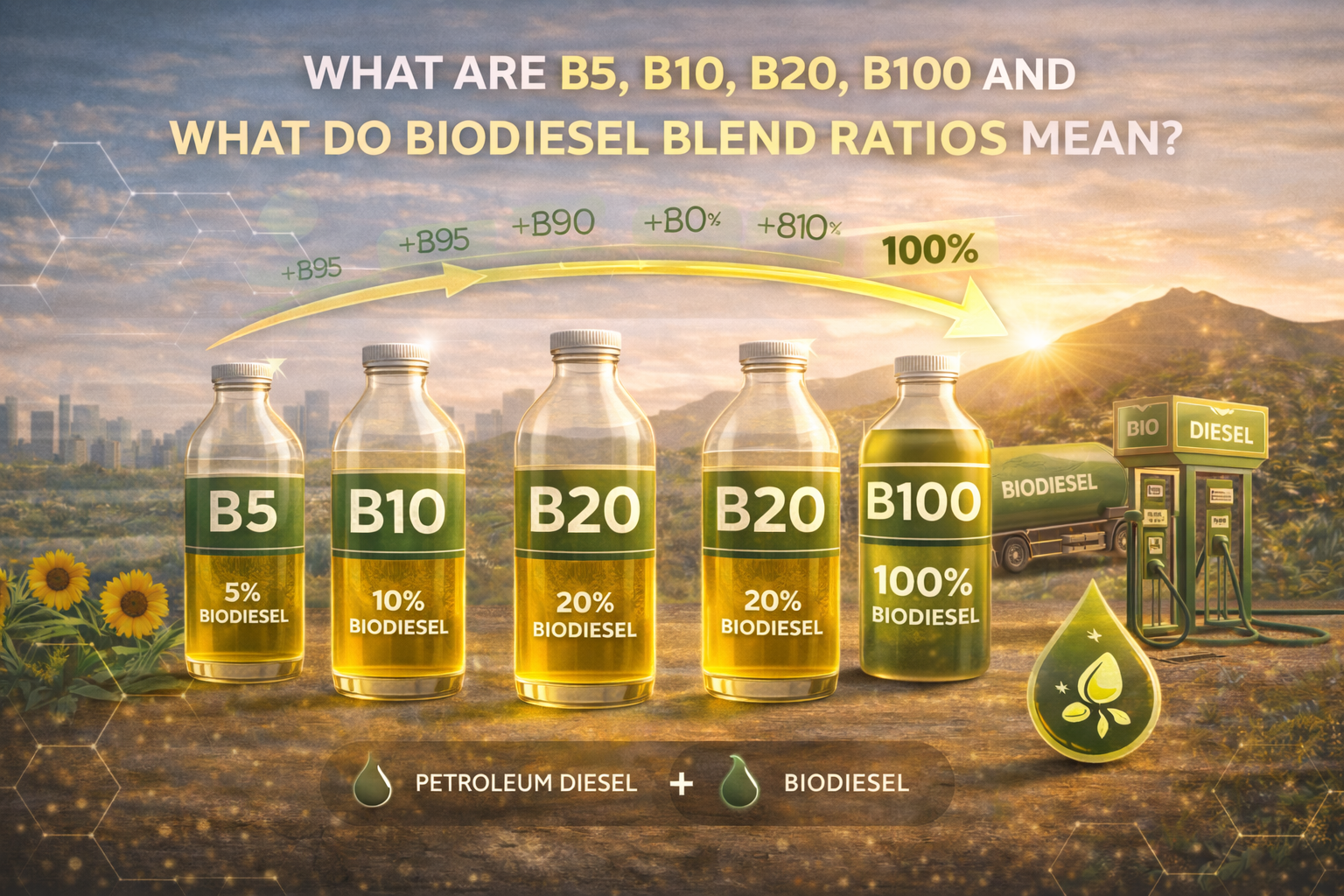
As India accelerates its transition toward cleaner and more sustainable energy sources, biodiesel is emerging as a critical component of the country’s fuel strategy. However, many businesses, fleet operators, and even industry professionals often get confused by terms like B5, B10, B20, and B100. These are not just technical labels, they directly impact fuel performance, emissions, cost efficiency, and regulatory compliance.
Understanding biodiesel blend ratios is essential for anyone involved in transportation, logistics, manufacturing, or energy production. Whether you are running a fleet, operating a biofuel plant, or exploring renewable fuel options, knowing what each blend represents can help you make smarter, future-ready decisions. This guide breaks down everything in a clear and practical way, with a focus on the Indian context.
What Are Biodiesel Blend Ratios?
Biodiesel blend ratios refer to the proportion of biodiesel mixed with conventional petroleum diesel. The naming convention is straightforward: the letter “B” stands for biodiesel, and the number following it represents the percentage of biodiesel in the blend. For example, B20 means 20% biodiesel and 80% fossil diesel, while B5 contains only 5% biodiesel.
These blends are designed to balance sustainability with practicality. Pure biodiesel offers environmental benefits but may require engine modifications, while lower blends ensure compatibility with existing diesel engines. This is why governments and industries adopt different blends depending on infrastructure readiness and policy goals. In India, the focus is gradually shifting toward higher blends, making biodiesel blend ratios a key factor in long-term energy planning and fuel standardization.
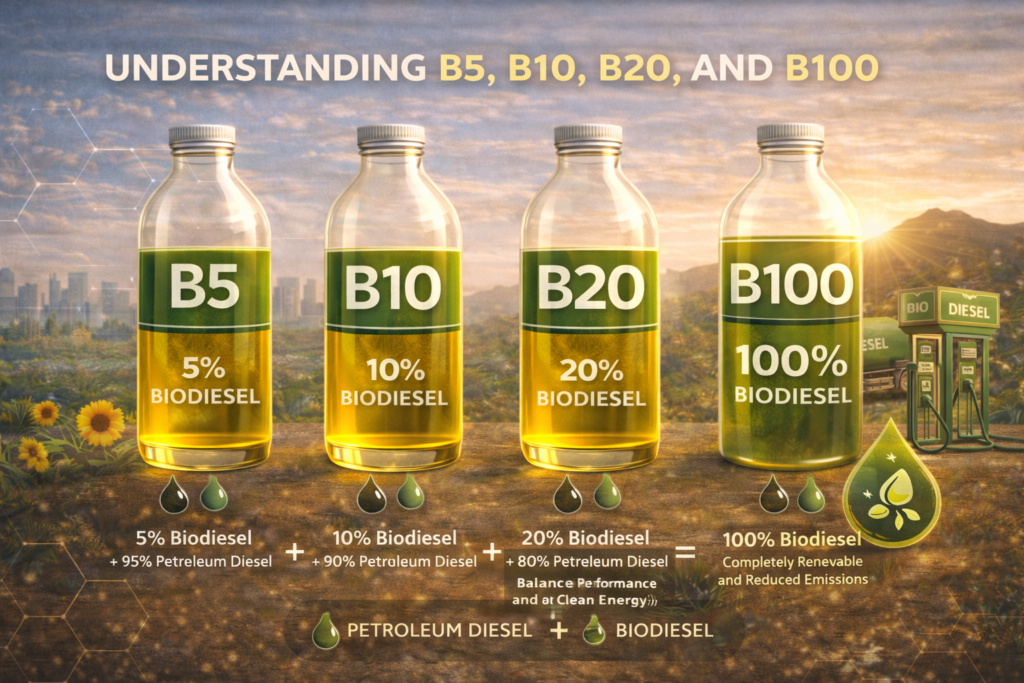
Understanding B5, B10, B20, and B100
B5 Biodiesel Blend
The B5 blend contains 5% biodiesel and 95% conventional diesel, making it one of the safest and most widely accepted fuel options globally. It is often used as a default blend because it requires no engine modifications and maintains nearly identical performance characteristics to standard diesel. For businesses, this means a seamless transition without operational disruptions.
From an environmental standpoint, B5 offers a small but meaningful reduction in emissions, especially in terms of particulate matter and carbon monoxide. While it may not deliver dramatic sustainability gains, it acts as an important stepping stone toward higher blends. In markets like India, B5 can be easily integrated into existing fuel supply chains, making it a practical entry point for adopting biodiesel blend solutions without significant risk.
B10 Biodiesel Blend
B10 consists of 10% biodiesel and 90% petroleum diesel, offering a stronger environmental advantage compared to B5 while still maintaining high engine compatibility. It is increasingly being adopted in regions that want to reduce emissions without compromising on performance or infrastructure.
One of the key advantages of B10 is its ability to lower greenhouse gas emissions and improve lubrication in engines, which can slightly enhance engine life. For fleet operators and businesses, this blend strikes a balance between sustainability and reliability. As India continues to explore higher blending targets, B10 can serve as a transitional phase that prepares industries for broader adoption of biodiesel blend ratios. It represents a step forward without requiring major changes in vehicle technology or fuel distribution systems.
B20 Biodiesel Blend (Focus on India)
B20, which contains 20% biodiesel and 80% diesel, is widely considered the most practical and impactful blend for large-scale adoption. It offers significant emission reductions while maintaining compatibility with most modern diesel engines. This makes it especially relevant for commercial fleets, public transport systems, and industrial operations.
In the Indian context, B20 biodiesel India is expected to play a transformative role in reducing dependence on imported crude oil and improving energy security. It also supports waste-to-energy initiatives by utilizing feedstocks like used cooking oil (UCO). Compared to lower blends, B20 delivers a noticeable reduction in carbon emissions, making it a strong candidate for policy-driven implementation. For businesses, adopting B20 means aligning with future regulations while also contributing to sustainability goals in a cost-effective manner.
B100 Meaning in India
When discussing B100 meaning India, it refers to pure biodiesel without any blending with petroleum diesel. Also known as neat biodiesel, B100 is typically produced from renewable sources such as vegetable oils, animal fats, or recycled cooking oil. While it offers the highest level of emission reduction, its direct use is limited due to certain technical challenges.
B100 can have different cold flow properties and may affect engine components if used without proper modifications. This is why it is most commonly used as a base fuel for creating blends like B20 or B10 rather than being consumed directly. In India, B100 plays a crucial role in the supply chain of biodiesel production, acting as the foundation for all biodiesel blend formulations. It is essential for scaling the biofuel ecosystem, even if its end-use remains limited.
Why Biodiesel Blend Ratios Matter
Understanding biodiesel blend ratios is not just about fuel composition—it directly impacts engine performance, environmental sustainability, and overall operational costs. Different blends offer varying levels of emission reduction, with higher blends generally resulting in lower greenhouse gas emissions and improved air quality.
From a technical perspective, lower blends like B5 and B10 ensure compatibility with existing engines, while higher blends like B20 and B100 may require evaluation based on engine type and usage conditions. Economically, businesses must balance fuel costs with sustainability benefits. In India, where regulatory frameworks are evolving, choosing the right blend can also influence compliance and long-term viability. Ultimately, selecting the appropriate biodiesel blend helps businesses optimize performance while contributing to national energy and environmental goals.
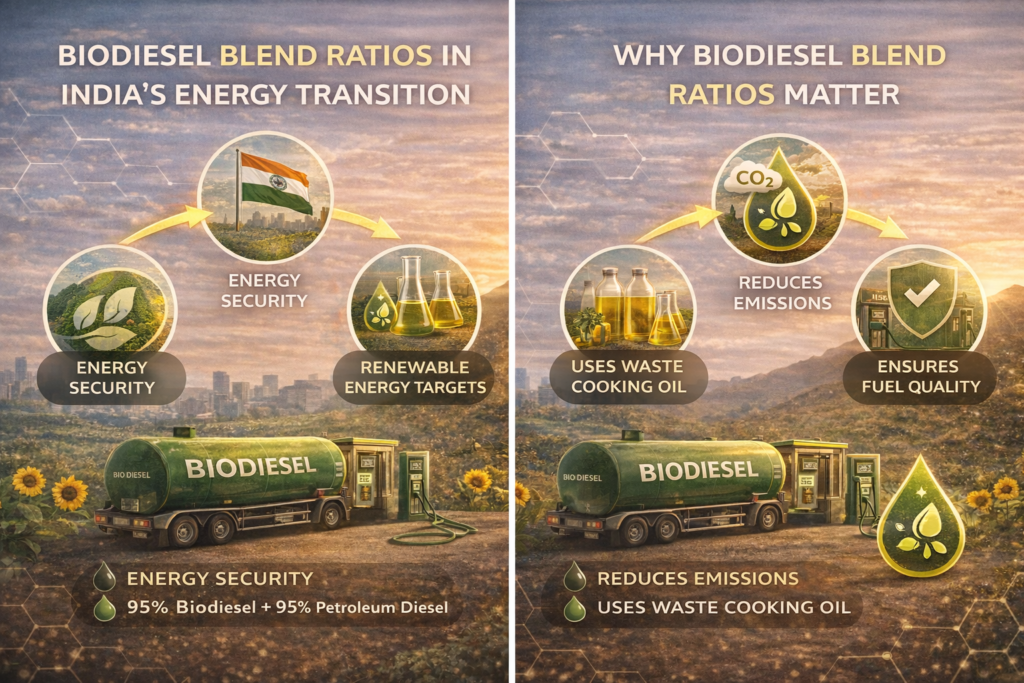
Biodiesel Blend Ratios in India’s Energy Transition
India’s push toward renewable energy has gained momentum, especially after the success of ethanol blending programs. Now, attention is shifting toward biodiesel as a complementary solution for decarbonizing the transport and industrial sectors. In this transition, biodiesel blend ratios are becoming increasingly important.
The adoption of B20 biodiesel India is expected to be a key milestone, driven by government policies and sustainability targets. It enables the use of alternative feedstocks like used cooking oil, reducing waste and promoting circular economy practices. Additionally, biodiesel helps lower import dependency, which is crucial for economic stability. As infrastructure and awareness improve, higher blends may become more common. For businesses and investors, understanding these trends is essential to stay ahead in India’s rapidly evolving biofuel landscape.
Conclusion
As India moves toward a cleaner and more sustainable energy future, understanding biodiesel blend ratios becomes increasingly important for businesses, policymakers, and consumers alike. While lower blends like B5 and B10 provide an easy entry point, B20 biodiesel India stands out as the most viable option for large-scale implementation due to its balance of performance and environmental benefits.
At the same time, understanding B100 meaning India is essential for those involved in biodiesel production and supply chains. It forms the backbone of all blends and plays a critical role in scaling the industry. By adopting the right biodiesel blend, businesses can not only improve efficiency but also align with future regulations and sustainability goals, ensuring long-term growth and relevance in a rapidly changing energy landscape.
Frequently Asked Questions
1. What is the most commonly used biodiesel blend?
Globally, B5 and B20 are the most commonly used biodiesel blend ratios because they offer a good balance between compatibility and environmental benefits. B20, in particular, is gaining traction in India due to policy support and its effectiveness in reducing emissions.
2. Is B20 safe for vehicles in India?
Yes, B20 biodiesel India is generally safe for most modern diesel engines without requiring modifications. It is widely considered a practical blend for commercial and personal use, offering improved sustainability without compromising engine performance.
3. Can B100 be used directly in vehicles?
While B100 meaning India refers to pure biodiesel, it is not always suitable for direct use in standard engines. It may require modifications and is primarily used as a base for creating other biodiesel blend options like B20 or B10.
4. Does biodiesel affect engine performance or mileage?
In most cases, lower blends like B5 and B10 have negligible impact on engine performance or mileage. With higher blends such as B20, there might be a slight variation in fuel efficiency due to lower energy density, but it is usually minimal. Overall, using the right biodiesel blend ratios ensures smooth engine operation while improving lubrication and reducing engine wear over time.
5. Is biodiesel easily available in India?
The availability of biodiesel is steadily improving as India strengthens its biofuel ecosystem. With government support and increasing adoption of B20 biodiesel India, more fuel stations and suppliers are entering the market. Additionally, initiatives promoting used cooking oil (UCO) collection are helping scale production, making different biodiesel blend options more accessible for commercial and industrial use.